
Leveraging Automation to Address Labor Shortages in Industrial Sectors
The industrial revolution paved the way for industrial automation, and it has made a huge impact in the years that have followed. Now, amid the Fourth Industrial Revolution, or Industry 4.0, automation and technological advancements play a bigger role than ever.
Those first automated machines addressed the needs of the times and freed the labor force of repetitive and menial labor. Today’s automated technologies are revered for solutions to modern problems, like industrial workforce and labor shortages.
Discover how leveraging automation can address labor shortages in the industrial sectors.
The Growing Challenge of Labor Shortages
According to the US Chamber of Commerce, the US is experiencing significant labor shortages. These shortages can have varied consequences for the industries involved. The industrial sector, especially, experiences several challenges when it does not have an adequate workforce.
A reduced workforce means productivity slows down. When the shortage is severe, some processes can even grind to a halt. This causes major delays in the fulfillment of orders.
Overburdened employees can make critical errors, and skill gaps worsen the problem. Without enough skilled workers for each process, product quality inevitably suffers.
Operational expenses can also rise as the limited pool of skilled workers demand higher wages, realizing their increased value. Unfortunately, this can easily lead to protracted disputes.
Workforce shortages differ between the various industries and sectors and from one state to the next, but most industries are experiencing them. Without labor shortage solutions like automation, the most affected states and industries cannot remain productive and competitive.
How Automation Mitigates Workforce Gaps
Unfortunately, workforce gaps are often the hardest felt in areas requiring the most specialized skills. As workers with years of experience and expertise retire from the workforce, there are not always enough young people ready and willing to follow in their footsteps.
Workforce automation mitigates the workforce gaps that widespread labor shortages have caused.
Automated processes play a critical role in operations from the forest floor to the factory floor, and from the manufacturing site to the construction site. It can be used for remotely operating industrial machinery, conveying goods, sorting aggregates, and even loading orders ready to ship.
Not Always a Labor Replacement, But Also a Labor Supplement
When automation first entered the industrial sector, there were fears that it would completely replace human labor. While the race is on to deploy AI-driven technologies that may replace many workers by 2030, this fear is largely unfounded.
Automation and other technologies can handle a high share of jobs very efficiently. It is the savior of businesses struggling with too few skilled workers. But automation is as useful to businesses with a full workforce as it is to those with a dwindling labor force.
Automated control helps businesses improve accuracy, efficiency, and productivity. When businesses implement automated technologies, they can scale their operations, taking on more orders and bigger orders without hiring new workers.
Automation has heeded the call for safer working conditions, too. It is the ideal solution in industries with hazardous working conditions, allowing operations to continue and even thrive while keeping workers safe.
Automation Success Stories from Various Industries
It’s not just the industrial sectors benefiting from automation and technology. Various industries are reaping the rewards of automated processes.
- Quality Control: Automobile manufacturers are known for their high level of automation and AI-driven technology, such as the electric vehicle manufacturer, Tesla, Inc.
- Manufacture and Assembly:The aerospace industry, for example, Boeing, uses industrial robotics and automation for more accurate drilling and countersinking of rivet holes and assembling aircraft components.
- Safety Testing: Defense contractors like Lockheed Martin leverage automation to test the precision and safety of military defense systems.
These are just a few examples of big industries and companies using automation. The great thing about automation technology is that it can be scaled and customized for any industry or company’s specific needs.
Make Automation Work Harder for You
Automation technology can mitigate growing labor shortages and skills gaps. But it also solves other issues that industrial sectors face. This is how you can make automation work harder for you.
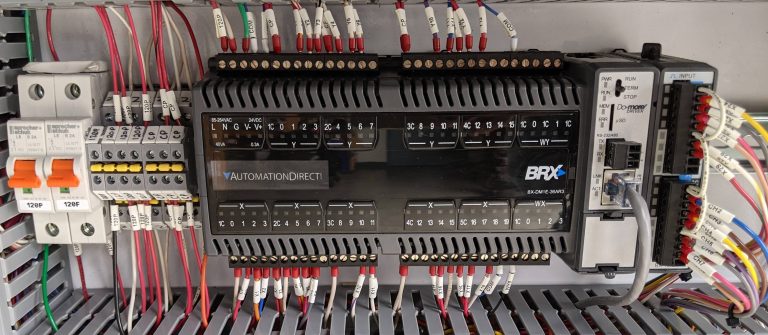
- Specially designed control panels will keep your automated systems operational in even the most extreme environments.
- Automated equipment can keep your workers safe in hazardous conditions and reduce workplace incidents.
- Automation can reduce waste and improve energy efficiency to meet your industry’s sustainability guidelines.
Conclusion
Implementing custom automation is undoubtedly the best decision you will ever make for your business. Most importantly, you can mitigate workforce gaps and remain competitive during times of labor shortages.
AEC is a licensed ETL 508A panel building shop. We specialize in building custom control panels but also offer standard panel parts and services. Our expertise in various industries including the aggregate, food processing and forest products sectors allows us to meet all types of workforce automation requirements. Contact us today for your automation and control needs.
Svend Svendsen is the principal owner and a certified electrical engineer at Automation Electric & Controls Inc. Svend has decades of panel building experience specializing in custom industrial control systems, motor control panels, operator consoles, automated control systems, and custom control trailers. Automation Electric and Controls Inc. is a licensed ETL 508A panel building shop.