
How Automation Can Solve Key Labor Shortages in Industrial Operations
Industrial automation has changed the face of countless industries as it has numerous benefits, such as higher productivity and precision, and of course, cost-efficiency. It is also one of the most effective labor shortage solutions.
But how does automation solve the issue of labor shortages in the industrial sector? More importantly, will it continue to fill the workforce gap amid the growing demands of the future? Read on to uncover the facts.
The Role of Automation in Reducing Dependence on Human Labor
Industrial automation has always had many advantages. The only real argument against it was that it would replace the human workforce. But the focus of industrial automation has always been a matter of labor efficiency, rather than labor replacement.
Automated processes handle tasks faster and more accurately than human workers. While it does reduce dependence on human labor, this is typically a positive thing. There are fewer workplace incidents and injuries, which means harsher environments become safer places to work.
Reduced dependence on human labor is also a big plus in industries facing labor shortages.
The Labor Shortage Challenge in Forestry, Aggregate, and Food Processing
In recent years, the news has been filled with reports of labor shortages.
The U.S. Forest Service has struggled to meet the workforce needs in Alaska, and there’s a national shortage of construction workers. Even the food processing industry has had its labor challenges, as working conditions in this industry are not particularly appealing to new, young job seekers.
The U.S. is not alone in this problem. Canada’s forestry sector has been facing a labor shortage too. This is mostly due to large populations of older forestry workers retiring, while younger generations show little interest in the field.
Reasons For Labor Shortages
Unappealing, challenging, tedious, or hazardous working conditions make younger generations think twice about following certain career paths. And as older generations retire from these jobs, there just aren’t enough younger workers with the necessary skills ready to take their place.
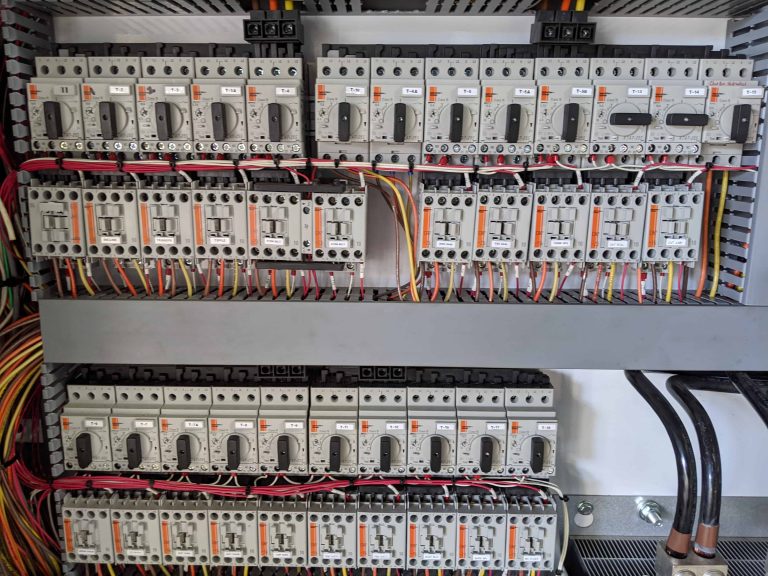
Just as there are different reasons for these labor shortages, there are different approaches to meeting these challenges. However, one of the most effective solutions for all industries is to invest in automation. And thanks to custom automated control panels, automation can be tailored to every work environment.
Custom Control Panels as a Solution to Labor Gaps
Automation is not a one-size-fits-all solution. It allows a high degree of customization. Thanks to custom control panels, every sector, industry, and company can address its particular needs, despite skill gaps in the working population.
But custom automation and control do so much more than fill in labor gaps. It aids your human workforce in meeting productivity targets and maintaining product quality. And best of all, robust custom control panels allow the operation of equipment from a safe distance in hazardous environments.
You may need higher productivity in your food processing plant than your workforce is capable of, to meet increasing demand for your products. You might need more accurate aggregate sorting to meet the high standards of your customers. Perhaps you just need safer working conditions for your forestry workers.
Whatever the case, custom automation and control will deliver the results you’re looking for.
Future Outlook: Will Automation Bridge Labor Shortages?
Will automation continue to bridge the gap, and what does this mean for the available workforce?
Automation is not intended to replace human workers. Their skills, years of experience, and hard-earned expertise make the workforce invaluable to all industries. They will continue to play a role in the success of primary industries like forestry, aggregates, and food processing.
However, it cannot be denied that these and other industries face serious labor challenges.
More and more young people are choosing to work in offices or online, rather than in a factory, on a worksite, or out in the field. Therefore, the use of custom automation and control as a labor shortage solution is likely to continue for the foreseeable future.
As technology advances, more automation will leverage Artificial Intelligence (AI), Machine Learning (ML), and the Internet of Things (IoT). The benefits for forestry, aggregate, food processing, and other industries, will only increase.
Conclusion
Key labor shortages affect multiple industries in the U.S., Canada, and elsewhere. Some industries simply don’t appeal to younger generations of workers. While the reasons for this are not always simply solved, the resulting labor shortages can be — with custom automation and control.
At AEC, we build custom control panels that meet ETL/UL 508A certification requirements. We supply all the parts needed to maintain your automation and control equipment in the future. And we service everything we build or sell. Contact us for all your automation and control needs.
Svend Svendsen is the principal owner and a certified electrical engineer at Automation Electric & Controls Inc. Svend has decades of panel building experience specializing in custom industrial control systems, motor control panels, operator consoles, automated control systems, and custom control trailers. Automation Electric and Controls Inc. is a licensed ETL 508A panel building shop.