
Understanding Short Circuit Current Rating (SCCR) on Industrial Control Panels

Every industrial control panel installed under the National Electrical Code has to have a Short Circuit Current Rating. The rating shows up on the UL label as an SCCR number. The panel builder is responsible for calculating it correctly.
This article walks through what SCCR actually is, how it gets calculated, and what to do if a panel does not meet the requirements.
What is Short Circuit Current Rating?
Short Circuit Current Rating, or SCCR, is the maximum amount of fault current a control panel can withstand without failing. Fault current is the current that flows when a short circuit occurs somewhere in the panel.
SCCR is expressed in kiloamps, usually written as kA. A panel rated 22 kA can survive a fault of 22,000 amps at the input terminals without coming apart. Above 22 kA, the components inside the panel are not guaranteed to contain the fault.
Why does SCCR matter for your control panel?
Because the National Electrical Code requires it.
NEC 409 says an industrial control panel has to carry an SCCR, and that rating has to be equal to or higher than the available fault current at the point where the panel is installed.
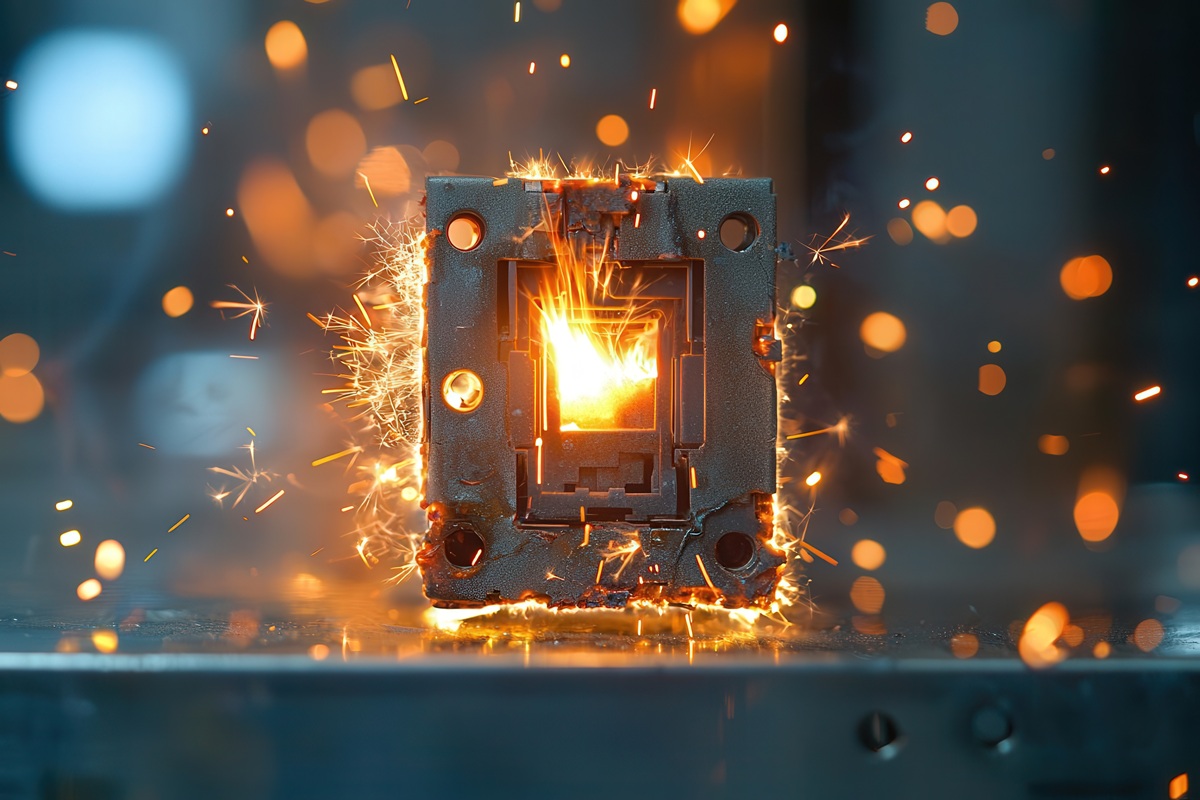
A panel installed at a location where the available fault current exceeds its SCCR is a hazard. During a fault, components inside the panel can rupture, arc, or catch fire.
How is SCCR calculated?
UL 508A Supplement SB defines the methods for calculating SCCR. The calculation looks at every component in the panel that carries fault current and identifies the weakest link. That weakest component sets the panel’s overall SCCR.
The process works like this. Each component gets evaluated against its individual short circuit rating from the manufacturer. Components in series can sometimes get combined ratings when the upstream device is current-limiting. The lowest rating in the fault current path is the panel’s SCCR. Getting this right requires working knowledge of the components, the standard, and the shop’s documented calculation procedures.
What components usually limit a panel’s SCCR?
A few components tend to keep panel ratings low if the design does not account for them:
- Small control transformers with low short circuit withstand ratings.
- Power distribution blocks that are only rated for 10 kA or less.
- Small circuit breakers used for control power.
- Older starter and overload combinations that were not tested for higher SCCR.
- Terminal blocks and wire that were not sized for the fault current expected at the input.
The panel builder has to select components that either meet the required SCCR on their own or that can be combined with current-limiting protection upstream to achieve the required rating.
How do you raise the SCCR of a panel?
Several options exist. The right one depends on what is limiting the rating.
- Replace the limiting component with a higher-rated part. If a small distribution block is the weak link, swapping it for a higher-rated block raises the panel’s SCCR without changing anything else.
- Add current-limiting fuses upstream of the limiting component. A properly selected current-limiting fuse can reduce the fault current the downstream component sees, effectively raising the combined rating.
- Use series-rated combinations documented by the component manufacturers. UL recognizes series ratings for specific breaker-and-fuse or breaker-and-breaker combinations that are tested together.
- Size feeder conductors and transformers to reduce the available fault current at the panel. This is a system-level change that affects more than just the one panel.
Each of these approaches has to be reviewed against UL 508A and documented on the panel label. A shop that raises SCCR without following the standard produces a panel that will fail inspection.
What if an existing panel is undersized for its location?
You have four options, in rough order of cost:
- Relocate the panel to a location with lower available fault current. Sometimes possible on large facilities where the panel can move closer to a subpanel with more upstream impedance.
- Add upstream current-limiting protection. A current-limiting fuse or breaker on the feeder can reduce the fault current the panel sees.
- Modify the panel to raise its SCCR. Replace limiting components or add internal current-limiting devices. Requires the panel to come back to a licensed shop or be evaluated on site by a UL field inspector.
- Replace the panel entirely. Sometimes the fastest path if the panel is old, undocumented, or already showing signs of end-of-life.
What does the shop need from you to calculate SCCR?
The available fault current at the install site is the key input. That number typically comes from the utility or from a short-circuit study performed on the facility’s electrical system. Without it, the shop is working blind.
Other useful information includes the panel’s rated voltage, the size and impedance of the upstream transformer, and the length and size of the feeder conductors between the transformer and the panel. All of these affect the fault current that will actually be present at the panel’s input terminals.
Working with AEC on your panel’s SCCR
AEC is a licensed UL 508A panel shop. Every panel we build carries a calculated SCCR documented on the label, with the calculation performed under Supplement SB of the standard.
If you have a project coming up and need a panel that will pass inspection at the install site, get in touch. Tell us the load requirements and the available fault current at the location, and we will build a panel rated to match.
Frequently asked questions
Is SCCR required by law?
SCCR is required by the National Electrical Code, which most state and local jurisdictions adopt. NEC 409 specifies that industrial control panels have to carry an SCCR marked on the panel. In practice, your electrical inspector enforces this.
What does the default 5 kA rating actually mean?
It means the panel builder did not calculate an SCCR and defaulted to 5 kA. The panel can only be installed at locations where the available fault current is 5 kA or less. Most industrial locations exceed that number.
Can I raise my panel’s SCCR after it is built?
Sometimes. Options include replacing limiting components, adding current-limiting fuses upstream, or using recognized series-rated combinations. Any modification has to be reviewed under UL 508A and documented on a new label. Field modifications done without that review can void the listing.
Where do I find the available fault current at my install site?
Ask your utility. They can provide the available fault current at the service transformer. For accurate numbers at a specific panel location, a short-circuit study performed by an electrical engineer is the reliable source.
Does every component in the panel need its own short circuit rating?
Every component in the fault current path needs a rating high enough to handle the fault current at that point in the panel. Components off the fault current path, like small control circuits protected by fuses, are handled differently under the standard.
Can I install a 10 kA panel at a 25 kA location if I add a fuse upstream?
Sometimes, if the upstream fuse is current-limiting and is documented as a series-rated combination with the components inside the panel. This has to be documented and approved under UL 508A. Adding a random fuse and hoping for the best is not compliant.
Svend Svendsen is the principal owner and a certified electrical engineer at Automation Electric & Controls Inc. Svend has decades of panel building experience specializing in custom industrial control systems, motor control panels, operator consoles, automated control systems, and custom control trailers. Automation Electric and Controls Inc. is a licensed ETL 508A panel building shop.