
Preventing Accidents with Emergency Stop Buttons

Most industrial machines have an emergency stop button. They have various shapes and sizes, but they function the same. They stop the machine from operating in case of an emergency. These safety devices have can be added with custom motor controls, industrial motor controls, and tied into electrical automation. Their use is universal and is mandated by many safety organizations. Are you familiar with them? If you don’t know how they work, what they look like, and how to add them to ensure worker safety, we’ll discuss why they are a necessary addition to prevent accidents.
What Are Emergency Stop Buttons?
Emergency stop buttons are fail-safe controls designed to immediately stop equipment from operating. The function of the stop buttons is to open the electrical circuit to eliminate power connection to a piece of equipment or circuit panel. Once activated, the switch stays open and will not transfer power again until intentionally reset when safe conditions are restored. The reset function can be a simple twist of the button, operated by a key, or a pulling motion on the button.
Emergency stop buttons have three main components: an actuator, a contact block, and a holder.
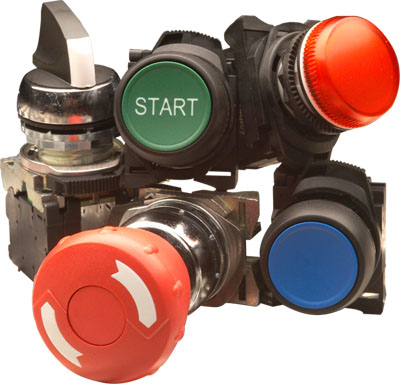
- The Actuator is the interface for the human operator to use. It is the red mushroom shaped button that is pressed to disconnect power to the equipment or control panel.
- The Contact Block houses the wiring terminals that power goes through. They have two configurations: normally open (NO) and normally closed (NC). The configurations indicate the initial position of the contact prior to being activated. Normally closed (NC) contacts are typically used in emergency stop (e-stop) applications as they will prevent or disconnect power when activated.
- The Contact Block Holder connects the Actuator to the Contact Blocks as it holds the pieces when installed and used.
There are 3 main types of Actuators available:
# 1 – Push-pull type: the actuator is pushed in to disconnect power and pulled out to reconnect the power.
# 2 – Twist-release type: the actuator is pushed in to disconnect power and twisted to reconnect the power.
# 3 – Key-release type: the actuator is pushed in to disconnect power and a keyed switch is used to reconnect power.
Many of the workplace safety standards mandate that an emergency stop switch have a red actuator button and a yellow housing / background. They yellow can be shown with a yellow enclosure, a large emergency stop legend as an indicator, or a yellow stem for the push button.
What Makes an Emergency Stop Button Different?
Many control panels and pieces of equipment have a start and stop button, plus the addition of an emergency stop button. Why do you think that is? The start and stop buttons are meant to be used for daily operations. The machine or control panel may have power connected, and these buttons may just control certain operations. The emergency stop (or e-stop) button disconnects all power from the panel and/or equipment. Nothing will work as it is meant to prevent or stop a workplace hazard.
The e-stop buttons are larger in size than typical start and stop buttons as it needs to be easily accessible in a hazardous situation. They will have a large red mushroom actuator that is easy to see with no obstructions preventing their use.
What Common Mistakes are Made with Emergency Stop Buttons?
- Wrong application – most emergency stop buttons are normally closed, so that when activated they disconnect power transmission. Some workplaces have used normally open stop buttons and then connect them to a PLC or a separate relay to perform the disconnect function. In his case, the switch will not immediately disconnect power transmission and the equipment can still operate in a hazardous emergency. The power must be stopped by another relay or the PLC.
- Wrong occasion for use – emergency stop buttons should only be used in an emergency when a hazardous condition is present. In some occasions maintenance personnel will use the e-stop button to disconnect power from equipment prior to conducting maintenance operations. In this case, an unsuspecting person can reconnect the e-stop button and energize the equipment. Power should be disconnected properly from the equipment, and not by the e-stop button unless it is an emergency hazardous situation.
- Wrong usage habits – many new operators don’t fully understand how an e-stop button can affect daily operations. Emergency stop buttons will stop equipment from running, but they may also be tied into larger electrical control systems with alarms and workplace safety systems. Using an e-stop button to stop equipment at a break or at an end of shift may trigger a complete system shutdown and notify safety personnel of a hazardous situation that isn’t actually a real problem. Only use the e-stop button when there is a hazardous situation.
If your work environment can benefit from the addition or an upgrade to your current emergency stop buttons, we can design and build custom control systems that integrate stop buttons with Motor Control Centers and/or Operator Controls for a completely safe and cost-effective solution.
Automation Electric & Controls can help design and build your next custom Industrial Motor Control system to increase workplace safety. AEC is a licensed ETL 508A panel building shop, and we specialize in control systems and custom motor controls that assist businesses to run at their best. Our work can be integrated with new and existing electrical automation to operate industrial motor controls in a safe environment. Our work is defined by the quality products we produce. We offer consulting services, are locally owned in the Pacific Northwest, and stock a large inventory of products to keep your business running. When you’re ready for a new custom designed control system, a custom mobile trailer and container, or simply need support and consultation of a future concept, give us a call at (866) 452-6947 or email us at sales@automationelectric.com.
Svend Svendsen is the principal owner and a certified electrical engineer at Automation Electric & Controls Inc. Svend has decades of panel building experience specializing in custom industrial control systems, motor control panels, operator consoles, automated control systems, and custom control trailers. Automation Electric and Controls Inc. is a licensed ETL 508A panel building shop.