
Industrial Applications for Automated Control Systems
Automation is one subject that continues to grow with technology improvements and the need for greater time management. We are asked if an Automated Control System should be added in certain situations, and generally adding industrial automated control systems can have tremendous rewards. If you aren’t certain if your facility needs more controls in place, or if you need to add equipment to achieve new targets, we’ll discuss how adding Industrial Applications for Automated Control Systems can benefit you.
Why Are Automated Control Systems Needed?
Control systems are typically added or upgraded for three main reasons:
- More accuracy required – Increased accuracy can offer many benefits for your operations. It can decrease defects through more data analysis, prevent temperature variations that cause product damage and personnel discomfort, and increase production rates with better efficiency.
- More consistency – Whether you’re producing chemicals or generic widgets, consistency in your process can lead to huge gains in profit and efficiency without excessive associated downtime.
- More safety for personnel – Automated controls can add an extra level of safety for personnel. The more complex or potential dangers in the systems and facilities, controls can add safety protocols to keep employees safe.
What Added Benefits Can Automated Control Systems Offer?
Automated Control Systems can add these benefits to your operations:
- Control from multiple locations – Your locations can in the same building, or be across the country. The use of remote viewing via the internet makes multiple locations easy to maintain.
- Remote monitoring, troubleshooting, or program changes – Seeing all locations is just one benefit. You can also troubleshoot problems and make program changes to alleviate problems before they cause downtime and quality issues.
- Data logging – Raw data can be viewed as well as associated programs can calculate trends with graphs to visually showcase process conditions.
- A single plant wide interface – See everything from one interface without needing to spend time moving between locations.
- Restrictive access to settings or control through pass codes – Security and process control can be limited as needed to prevent changes
- Reduced labor costs or improved work conditions – One interface that can make changes and constantly review process operations reduces the need for multiple personnel spread across various areas.
- Product consistency with reduced waste – Product consistency with reduced waste can increase profits and reduce downtime and rework. Supply chains are already strained enough without needed pressure of extra materials required to complete orders.
If your work environment needs any of these functions and benefits, or requires specialized technology to operate safely, an automated system can offer the flexibility and control to keep business running smoothly. We can design and build custom automated systems that integrate with Motor Control Centers or Operator Controls for a complete cost-effective solution.
What Components Do Automated Control Systems Use?
- Contactors – An electric contactor is a large relay for switching electrical loads on and off in motors and other high-power loads. Many varieties are available and can be tailored for the individual system and/or application.
- Circuit Breakers – Molded case circuit breakers interrupt current flows in the event of a fault to protect devices from electrical damage. They have higher interrupting ratings than miniature circuit breakers to serve high power industrial and commercial applications.
- Relays/Timers – Relays are used when a machine or engine must control a circuit using a lower power signal, or when several circuits must be controlled using one uniform signal to keep electrical equipment running smoothly. Timers are used in numerous electronic devices to control a wide variety of resistive and inductive loads. There are a variety of relays and timers available depending upon application.
- Various Enclosures – We offer NEMA rated electrical enclosures of various dimensions and styles. Choices range from powder coated mild steel or stainless steel to non-metallic fiberglass reinforced polyester or polycarbonate construction. These enclosures are ideal for protecting electrical components and wiring against various hazards.
- Push Buttons – Operator Interfaces, push buttons and pilot lights provide machinery control and status indication. Variety of push buttons, switches, and specialty operators are used for individuals to operate and regulate control stations and equipment.
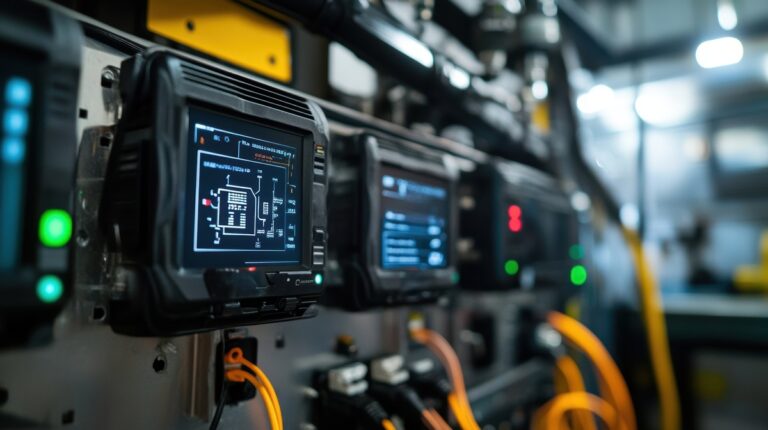
Industrial Applications for Automated Control Systems can help improve efficiencies and quality in your manufacturing processes. Programmable Logic Controllers (PLCs) are at the heart of most automated systems and they can offer superior flexibility to perform many tasks from replacing simple hardwired relay and timing circuits to maintaining precise control of your process with complicated math algorithms. Touch screens can be added to offer intuitive interfaces to these automated systems that can give them the information they need to keep your process running smoothly.
About Us
Automation Electric and Controls Inc. is also a licensed ETL 508A panel building shop. Our in-house design team offers complete solutions tailored to meet your business needs. Our quality inspections ensure that your custom-made Automated Control Systems meet your exact specifications. We offer startup and aftersales service for your complete systems, plus keep a large inventory of enclosures, breakers, motors, wire, relays, contactors, and much more. When you need immediate service, or the best price with the least amount of hassle, we’ll be there to assist you. Contact Us through our website or call (360) 428-0201.
Svend Svendsen is the principal owner and a certified electrical engineer at Automation Electric & Controls Inc. Svend has decades of panel building experience specializing in custom industrial control systems, motor control panels, operator consoles, automated control systems, and custom control trailers. Automation Electric and Controls Inc. is a licensed ETL 508A panel building shop.