
What Are The 3 Types Of Control Systems In Automation?
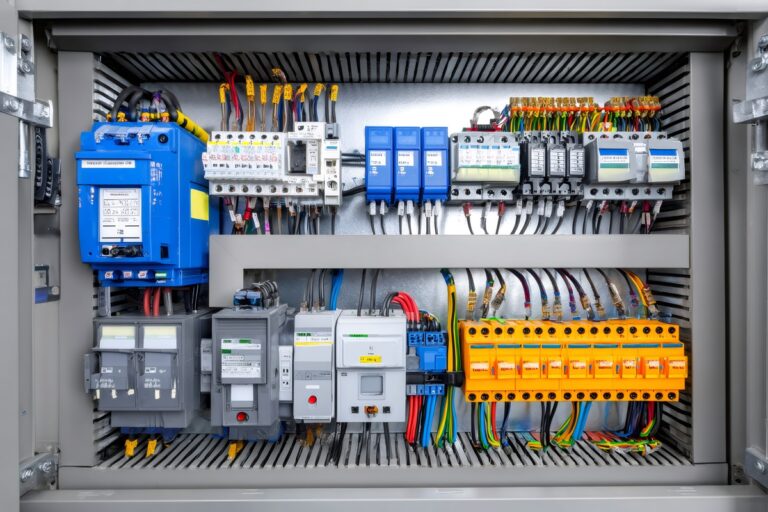
Industrial, processing, and manufacturing businesses use control systems to give commands to, direct the operations of, regulate, and manage their automated equipment. These control systems are crucial for any modern manufacturing or processing plant’s day-to-day processes.
Three types of automation control systems stand out across all kinds of industries. Your business needs ultimately determine your choice, although you may benefit from using more than one. In this article, we examine the three types of control systems and highlight which industries primarily use them.
The 3 Types Of Automated Control Systems
Three main types of automated control systems are Programmable logic controllers, distributed control systems, and programmable automation control systems.
Here is a short breakdown of each of them:
Programmable Logic Controllers (PLCs)
A PLC is essentially an industrial computer, built and ruggedized to withstand the harsh demands of the industrial environment. It controls electro-mechanical processes in manufacturing and processing plants through custom programming and via various inputs and outputs.
PLCs can handle both digital and analog inputs and outputs and often network to other computers and SCADA systems. Your particular needs will dictate the size, form, and programming involved. PLCs can also withstand electrical noise and vibration or extreme temperatures.
A PLC system needs a signal to initiate its program sequences, therefore input/output failure of any kind will disrupt your processes. Fixing such issues is not very difficult, but you must test and troubleshoot each port with a multimeter to find the issue.
PLCs are usually programmed with ladder logic and modeled after electro-mechanical relay systems. A PLC’s programming can include other programming, like Function Block Diagrams, Sequential Flow Charts, Instruction Lists, and Structured Text.
PLCs used to be the only viable industry automation control system. Older PLCs were often programmed exclusively with ladder logic, and the glass production industry still commonly uses these PLCs.
While this exclusive programming is no longer the case, PLC’s scalability and reliability make them popular in steel, chemical, and aggregate processing. The automobile production industry also uses them.
Distributed Control System (DCS)
A distributed control system is the solution when your system does not have a centralized control station. Unlike central operator supervisory control systems, a DCS is a computerized control system that uses multiple control loops.
The DCS reduces installation time and expenses and increases reliability by localizing control near your processing plants. This makes it easier for you to remotely monitor and supervise your processing plant.
The DCS functions similarly to the SCADA (Supervisory Control And Data Acquisition) system. Its scalability makes it more suitable than traditional PLCs for larger and more complex systems. However, PLC and DCS functionalities sometimes overlap. This is due to ongoing automated control innovation.
By distributing control processing along multiple system nodes, only one section of your plant’s processes will be affected in the event of a single failed processor. It is a stark contrast to the operations chaos that a centralized computer failure can cause.
DCSs are common in chemical production plants, oil refineries, and power generation plants. They are programmed with standardized IE 6 1131-3 languages, but the Erlang programming language is particularly suitable for DCS systems.
DCS systems interconnect sensors, actuators, controllers, and operator terminals via local area networks. They feature regularly in the petrochemicals industry, chemical plants, and paper mills. Nuclear and other power generation plants sometimes use these automated control systems, too.
Programmable Automation Controller (PAC)
A PAC is a digital computer for data acquisition and control and machine process control. It is similar to a PLC but has more advanced software features like those in a personal computer. A PAC can also operate in multiple domains simultaneously with a single platform.
PAC programmers use the same programming languages as in PLCs (those compatible with the international standard IE 6 1131-3). However, PACs are unique because they may include modern PC programming languages like C/C++.
This feature reduces the technological learning curve for your employees due to their likely familiarity with these PC programming languages. Automated production plants, food and beverage producers, the oil and gas industry, and water treatment facilities often use PACs for their various automation processes.
Conclusion
All of the above three types of control systems in automation allow computerized control of connected machinery, but each has unique strengths and benefits.
PLCs offer easy programmability and high reliability. PACs, while similar in function, offer the added convenience of modern PC programming languages. Because of their localized control, DCSs perform even in cases of processor failures.
At AEC, we understand how crucial it is for your industry to use the correct automated control system for your needs. Contact us for more information about what our motor controls can do for your automation processes.
Svend Svendsen is the principal owner and a certified electrical engineer at Automation Electric & Controls Inc. Svend has decades of panel building experience specializing in custom industrial control systems, motor control panels, operator consoles, automated control systems, and custom control trailers. Automation Electric and Controls Inc. is a licensed ETL 508A panel building shop.