Motor Control Panel Components Explained: A Complete Breakdown

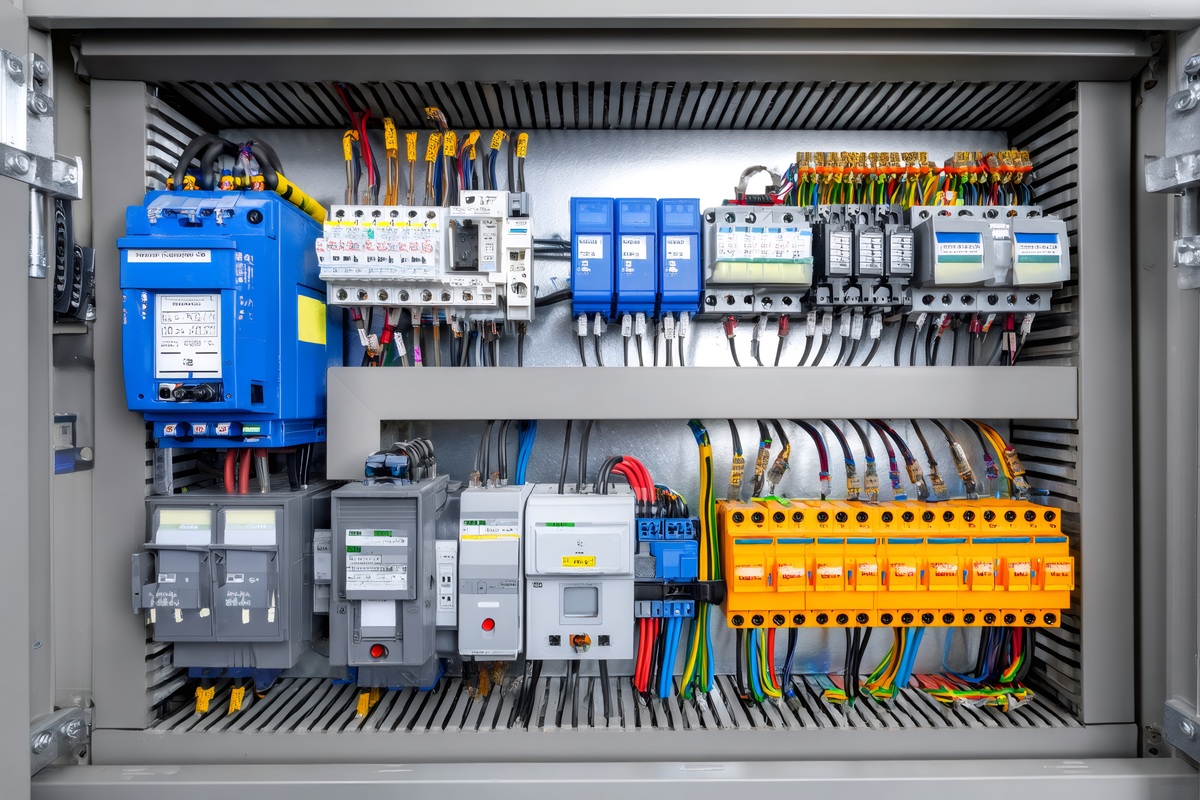
Open a motor control panel door and you see a wall of components. Each one is sized for a specific motor, picked from a UL-recognized list, and wired in a sequence that has to satisfy the National Electrical Code and the inspector. Get one wrong and the panel either fails inspection or fails in service.
AEC builds these panels. Here is what is inside one, what each part does, and how to decide which components to choose.
What does the main disconnect do?
The main disconnect isolates the panel from the supply and provides the first layer of current protection.
There are three common formats:
- Fused disconnect switch
- Circuit breaker
- Molded case switch with separate fuses
Choose the disconnect by its interrupting rating, which is how much fault current it can safely break. Motors draw a big surge of current when they start, often six to ten times their normal running current. The disconnect has to handle that surge every time the motor starts without tripping.
It also has to be sized correctly relative to the building’s main breaker. If a fault happens inside the panel, you want the panel disconnect to trip first. If the panel disconnect is undersized, the building’s main breaker trips instead, and the whole building loses power instead of just the one panel.
What is a motor starter?
A motor starter connects the motor to the line on a start signal and disconnects it on a stop signal. It is two components: a contactor and an overload relay.
What does an overload relay do?
An overload relay protects the motor from running too hot. Two technologies: thermal and electronic.
Thermal overloads bend a bimetallic strip when current exceeds the rating. Cheap, reliable, slow. Electronic overloads measure current with a CT and trip on a programmed curve. More accurate, more flexible, more expensive. For across-the-line starters on simple pump duty, thermal is fine. For motors that start ten times an hour or run on a VFD, electronic is the right answer.
When do you use a VFD instead of a starter?
Use a VFD when the motor needs to run at variable speed. The drive replaces both the contactor and the overload relay, converts incoming AC to DC, then chops the DC back into AC at whatever frequency the operator commands. The motor speed follows the frequency.
Variable speed can see energy savings of 30% or more compared to running wide open with flow controlled by a valve or damper. Process equipment gets precise speed control without mechanical gearboxes.
If the application only needs one speed, use a contactor and overload relay instead.
When do you use a soft starter?
Use a soft starter when the motor only needs one speed but the start has to be gentle. The soft starter ramps voltage up over a few seconds and controls the mechanical shock to the load.
Pumps, conveyors, and large fans are the typical applications. Starting these loads at full voltage shocks belts and couplings every time the motor kicks on. Soft starting reduces that stress and costs far less than a VFD
What are pilot devices?
Pilot devices are the buttons, switches, and lights on the panel door. Start, stop, e-stop, selector switches, indicator lamps, pilot lights. They are the operator’s only interface with the panel.
The right device depends on where the panel lives.
In a clean control room, basic plastic buttons work fine. In a wash-down area like a food plant, you need sealed metal buttons rated to keep water out, often with rubber covers over the buttons themselves. In a hazardous location with flammable gas or dust in the air, the buttons have to be rated for that specific hazard and built so a spark inside cannot reach the outside air.
How important is the wiring layout?
A panel with a clean wiring layout can save hours of troubleshooting when necessary.
- Wire color by function. Red for AC control, blue for DC control, yellow for foreign-source control, white for neutral, green for ground.
- Every wire labeled at both ends with a tag that matches the drawing.
- Terminal blocks numbered sequentially and grouped by circuit, not scattered.s
- Drawings inside the door that match what is actually in the panel, not what was originally designed.
Frequently asked questions
What is the difference between a motor control panel and a motor control center?
A motor control panel is a single enclosure containing controls for one or more motors. A motor control center, or MCC, is a modular assembly of multiple vertical sections, each holding one or more starter buckets. MCCs scale to dozens of motors and centralize service access. MCPs handle one machine or one process skid.
What does MCP stand for?
Two things, depending on context. Motor Control Panel is the assembly. Motor Circuit Protector is a specific type of branch circuit breaker used inside motor circuits. Always confirm which one the spec or quote is referring to.
Can I add components to a motor control panel after it is built?
Sometimes. Any addition changes the heat load, the wire fill, the SCCR calculation, and possibly the UL listing. Run changes past AEC before the work happens. Field modifications done without that review can void the listing.
What is the difference between NEMA and IEC contactors?
NEMA contactors are sized in coarse steps with conservative margin. IEC contactors are sized tighter to the actual load and run smaller. Both are recognized under UL 508A when applied correctly. NEMA dominates North American panels. IEC is standard everywhere else.
Final Thoughts
A motor control panel is only as good as the decisions behind it. The right disconnect, the right contactor, the right enclosure, and the right wiring practices add up to a panel that runs for decades. The wrong ones add up to a panel that fights you from the day it ships.
We are a licensed ETL 508A panel building shop specializing in custom industrial control systems, motor control panels, operator consoles, automated control systems, and custom control trailers.
If you have a project on the table, get in touch. Tell us what you need the panel to do and what equipment it has to control, and we will work through the specifics with you.
Svend Svendsen is the principal owner and a certified electrical engineer at Automation Electric & Controls Inc. Svend has decades of panel building experience specializing in custom industrial control systems, motor control panels, operator consoles, automated control systems, and custom control trailers. Automation Electric and Controls Inc. is a licensed ETL 508A panel building shop.