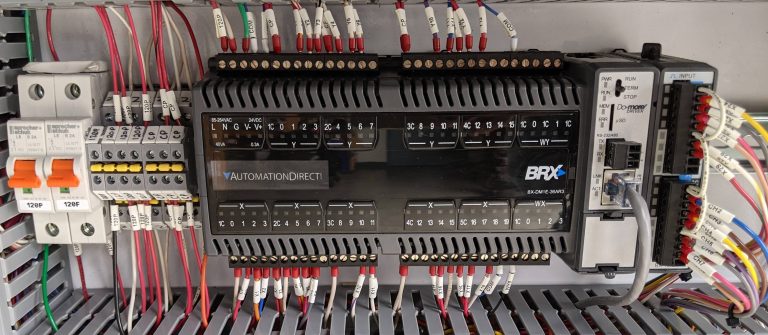

Implementing Advanced Process Control (APC) in Control Panel Design

The integration of Advanced Process Control (APC) into control panel design allows those in manufacturing and industry to optimize even the most complex systems. This integration is transforming modern automation, improving process stability, reducing variability, and maximizing efficiency.
This article explores the core components of APC, the benefits it brings to industrial operations, and the process of integrating it with control panels. We’ve also included some real-world examples to highlight how it can offer measurable performance improvements no matter which sector you’re in.
Understanding APC and Its Components
Advanced process control (APC) can be defined as techniques and technologies implemented within industrial process control systems, optionally and in addition to basic process controls.
The following components form a cohesive control strategy that improves operational resilience, product quality, and regulatory compliance:
- Model Predictive Control (MPC): APC can include Model Predictive Control to identify important process variables and the dynamic relationships between them. This facilitates predictions of future system behavior and is especially valuable in systems with multiple inputs and outputs that interact in complex ways.
- Multivariable control: Multivariable controllers handle interactions among multiple process variables. Instead of tuning individual loops, APC systems manage the entire process matrix, ensuring coordinated control actions across the system.
- Inferential sensors: In cases where direct measurement of key variables is impractical, inferential sensors estimate these variables based on correlated measurements. This enables better decision-making in processes that rely on indirect indicators.
- Real-Time Optimization (RTO): RTO algorithms adjust operating setpoints based on economic objectives and constraints, such as minimizing energy consumption or maximizing yield. By integrating with plant-wide control systems, RTO enhances overall efficiency.
- Data analytics and machine learning: Advanced APC systems often leverage historical data and machine learning to detect patterns, predict equipment failures, and continuously improve performance.
Benefits of APC in Industrial Processes
The adoption of APC in industrial processes has several benefits:
Process Stability
Traditional PID controllers can struggle with process variability caused by disturbances, nonlinear dynamics, or equipment wear. APC mitigates these challenges by making proactive control adjustments, resulting in more stable operations.
Quality
APC ensures consistent control of critical variables, leading to uniform product characteristics. In sectors where quality standards are tightly regulated, such as food processing, APC helps manufacturers stay within narrow quality limits.
Energy and Cost Savings
APC helps lower energy consumption and minimize waste by optimizing process variables and reducing variability. Facilities reduce raw material use, minimize waste from off-spec products, and use less energy. All of this contributes to lower operating costs.
Efficiency
Stable and optimized processes are pushed closer to their operational limits without sacrificing safety. This translates to higher output and better equipment utilization.
Compliance
APC systems can include logging and reporting capabilities. This supports compliance with environmental, safety, and quality regulations. Before deployment, employ rigorous testing and simulations for APC systems and their corresponding control panel interfaces to ensure performance in various scenarios.
Integrating APC with Control Panels
Implementing APC successfully requires thoughtful control panel integration.
- Sensors and instrumentation: Accurate, real-time data is the foundation of effective APC. Integrating high-precision sensors and ensuring clean signal routing within the control panel is essential. Pay attention to signal isolation, grounding, and shielding to avoid data distortion.
- Human-Machine Interface (HMI): The control panel’s HMI should provide intuitive access to APC diagnostics, trends, alarms, and manual overrides. This empowers operators to interact effectively with the APC system without advanced technical expertise.
- Data connectivity and networking: Because APC systems often run on separate computing platforms or cloud infrastructure, seamless data exchange is critical. Control panels must support secure communication protocols and network configurations that integrate with remote monitoring tools.
- Control logic and software: The control logic in the PLC or DCS must work in tandem with the APC algorithms. Edge computing platforms can link control panel logic with higher-level APC software, ensuring fast execution.
- Cybersecurity: As connectivity increases, so does vulnerability. Incorporate firewall protection, encrypted communication, user authentication, and intrusion detection systems to safeguard critical operations.
- Hardware: To handle the computational demands and data connectivity required for APC, control panels must have sufficient processing power and high-speed data acquisition systems. Communication modules (e.g., Ethernet/IP, Modbus TCP, OPC-UA) are also crucial.
Real-world Examples Highlighting Efficiency Gains
In our experience with APC integration in control panels, we’ve found its real-world potential for measurable process optimization.
- A food processing plant can integrate an APC into its control panel system to manage the drying process of high-moisture ingredients. By using inferential sensors and real-time optimization, the system can maintain ideal drying curves, reducing energy costs.
- An aggregate processing facility can adopt APC to optimize crusher feed rates and screen deck operations. Custom control panels that include vibration monitoring sensors and PLCs with predictive algorithms will proactively adjust process parameters, increasing efficiency and reducing downtime.
- A sawmill can integrate APC into log handling and cutting operations. Control panels would be updated to support real-time data from laser scanners and moisture sensors. APC software would adjust blade speeds and cutting patterns based on log characteristics. This can increase lumber yield and reduce blade and motor wear.
Conclusion
Control panel integration of advanced process control is the key to process optimization across industries. When implemented via robust control panels, APC delivers improved product quality and measurable efficiency gains.
Remain competitive in a data-driven manufacturing environment with control panels from AEC. We offer advanced custom control panels built to the highest standards and strong enough to withstand extreme environments.
Svend Svendsen is the principal owner and a certified electrical engineer at Automation Electric & Controls Inc. Svend has decades of panel building experience specializing in custom industrial control systems, motor control panels, operator consoles, automated control systems, and custom control trailers. Automation Electric and Controls Inc. is a licensed ETL 508A panel building shop.