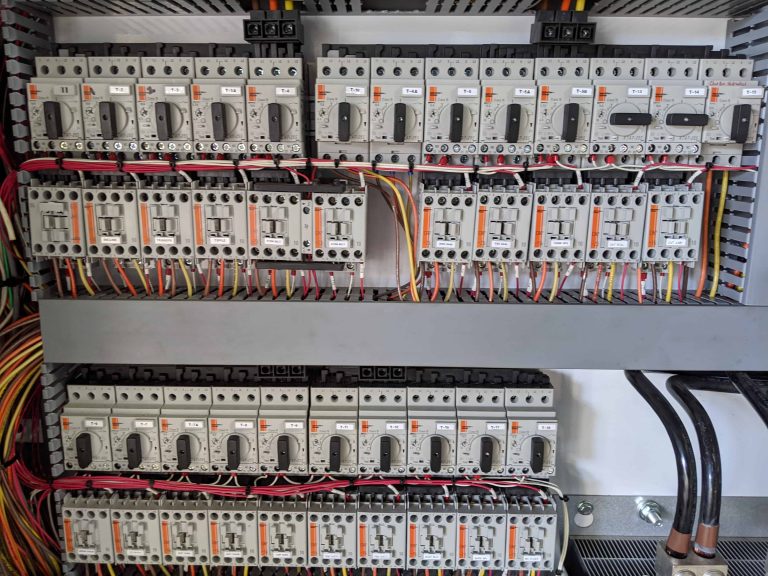

Harmonic Distortion in Industrial Control Panels
Harmonic distortions are a common problem in the industrial sector. They cause power inefficiencies and technical issues in industrial control panels and connected electronic equipment. But what are they, what accuses them, and more importantly, what can you do to mitigate these problems?
This short guide to harmonic distortion in industrial control panels has the answers.
Understanding Harmonics in Electrical Systems
Harmonics are very common in industrial settings. But when levels get too high, they can cause problems. Excessive harmonic distortions can shorten your equipment’s lifespan. But worse still, they can cause all kinds of havoc before the equipment fails.
Harmonics are voltage or current waveforms with frequencies that are whole-number multiples of the fundamental frequency (in most power systems, that is a frequency of 50 Hz or 60 Hz).
Voltage and current waveforms should ideally follow a smooth, sinusoidal pattern. But harmonics distort that smooth, sinusoidal shape and this is what can cause problems.
What Causes Them?
Harmonics are caused by electronic devices that don’t use electricity smoothly.
Non-linear loads draw in currents in brief, short pulses, distorting current waveforms and generating harmonics. These harmonic distortions disrupt the normal electrical flow, which can have detrimental effects on motors and other sensitive electronic equipment.
Impact on Motors, VFDs, and Sensitive Equipment.
Non-linear loads can cause waveforms to deviate from their typical shape. Uninterrupted power supplies (UPSs), electric variable frequency drives (VFDs), and other electronic devices that produce non-linear loads are therefore especially prone to harmonics.
These harmonic distortions can:
- Increase voltage and current levels, which can cause equipment like cables, motors, and transformers to overheat. This increased stress can degrade insulation and cause equipment to fail.
- Impact industrial power quality and causes power losses, which reduce efficiency while adding to the stress on electronic equipment.
- Interfere with capacitive or inductive elements in the system, causing resonance and amplifying harmonic currents and voltages.
- Lead to malfunctions in sensitive equipment such as meters, sensors, and protective relays. They can also trigger circuit breakers to trip.
Mitigating Harmonic Distortion with Filters and Active Solutions
When you’re dealing with nonlinear loads, harmonics are unavoidable. But that does not mean you have to sacrifice your equipment to the effects of harmonic distortions. There are steps you can take to mitigate the damage.
Proactive Harmonics Simulation and Planning
IEEE 519 standards for controlling harmonic distortion describe the voltage and current waveforms that can exist throughout systems and establish waveform distortion goals for system designers. Industries are expected to manage their harmonics to meet these standards.
The best course of action is to be proactive and plan for harmonic mitigation, to better comply with these standards. That means you need to start harnessing the power of your data.
By combining your VFD harmonics data and power supply data, you can simulate the harmonic impact that an entire industrial panel will have. This allows you to plan a harmonic mitigation strategy to align with harmonics standards for your industry, and also for your business’s specific needs.
Harmonic Filters
Filtering measures are commonly used for electrical noise mitigation. They can help when harmonic levels are too high.
Harmonic filters can be active, passive, or a hybrid of the two. Active harmonics filters introduce currents that are equal in magnitude, but opposite in phase, to the harmonic currents. Passive harmonics filters simply block the unwanted harmonics at a fixed frequency.
Passive filters can easily get overloaded. However, active filters, although typically more expensive, are more flexible and can adapt to changing loads. They don’t get overloaded as passive filters do and are therefore the better choice.
Pulse-Width Modulation
There are many benefits to using VFDs in industrial applications. Although older VFDs are a common source of harmonics, advanced VFDs can address the problem through pulse width modulation.
Smooth, sinusoidal waveforms are preferable in electrical systems, but harmonics interrupt these waveforms. However, the pulse width can be modified to resemble a sinusoidal waveform. This is known as sinusoidal pulse width modulation.
Pulse-width modulated (PWM) waveforms reduce harmonics and can minimize total harmonic distortion (THD). This reduces the need for harmonic filtering.
Conclusion
Is it possible to avoid the problem of harmonics? Not exactly, no. They are common in electronic equipment, and you’ll have to find a way to bring harmonic distortion in your control panels down to acceptable levels. Luckily, there are several ways you can address the problem of harmonics.
Do you want to protect your electronic equipment while ensuring seamless automation and control? AEC can help. We build custom control panels to your specifications, stock standard panel parts, and also service everything that we build or sell.
Contact us today for robust, resilient VFDs, motors, automation and control panels, and more.
Svend Svendsen is the principal owner and a certified electrical engineer at Automation Electric & Controls Inc. Svend has decades of panel building experience specializing in custom industrial control systems, motor control panels, operator consoles, automated control systems, and custom control trailers. Automation Electric and Controls Inc. is a licensed ETL 508A panel building shop.