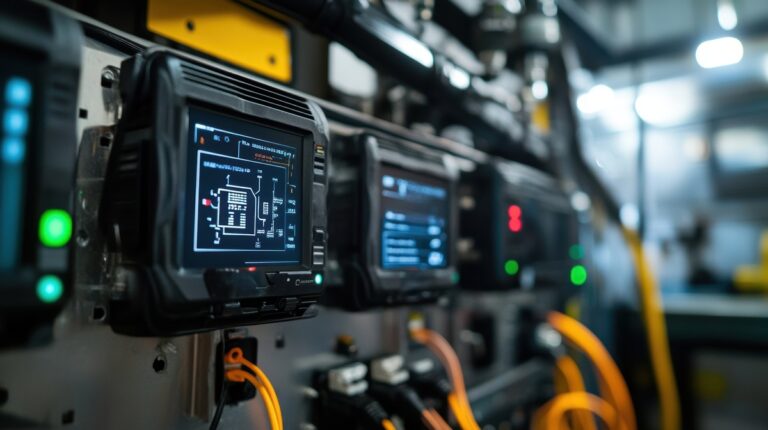

Advancements in Variable Frequency Drives (VFDs) That Enhance Motor Control

Variable frequency drives, or VFDs, vary the frequency and voltage of electric motors to adjust speed and torque. In doing so, they improve the overall efficiency of your industrial applications in various ways. What’s more, advancements in variable frequency drives maximize the benefits.
Want to know more about what the latest VFDs can do for you? Below, we examine how variable frequency drives enhance motor control in industrial applications.
Benefits of VFDs in Industrial Applications
Industrial automation offers many advantages, such as improved accuracy, efficiency, productivity, and safety. But by incorporating VFDs in industrial applications, you will get even better results.
By using VFDs, you can:
- Improve motor control. By matching the motor’s speed to what is needed for the task at hand, VFDs improve motor control and stability.
- Increase safety. Because they reduce the risk of mechanical faults and overloads, VFDs also increase safety during operation.
- Prolong your equipment’s lifespan. Due to a reduction in mechanical stress and unexpected shutdowns, VFDs prolong equipment longevity.
- Reduce energy consumption. VFDs offer the best motor speed and torque for each task and thus reduce excess energy use.
- Thanks to the combination of the above benefits, VFDs offer yet another benefit — they save you money!
VFDs improve motor control to enhance productivity and equipment lifespan. They also increase safety, minimizing costly workplace incidents. Lastly, they reduce energy consumption, further saving you money that would otherwise be wasted on higher energy usage.
Understanding the Latest VFD Technologies
VFD technology has kept in step with innovations in manufacturing and industry.
Today’s VFDs are more compact and also more affordable than in the past and can be controlled by other programmable controllers. It is also now possible to manage multiple motors with a single VFD. And thanks to new drive developments, new VFDs are compatible with a wider range of motors.
Modern VFDs can also control a wider range of variables besides speed and torque and have advanced energy-saving and fault-detection features.
Future Trends in VFD Development
So, what does the future hold for VFDs? The industrial sector is implementing innovations like Artificial Intelligence (AI), Machine Learning (ML,) and the Internet of Things (IoT) more and more each day. The latest VFDs are designed to accommodate these technologies.
Future VFDs will allow more remote monitoring and control, with built-in IoT capabilities as standard. They will be even more energy efficient, keeping in line with recommendations for sustainability. They will also leverage AI and ML to:
- optimize performance
- predict load fluctuations
- identify anomalies within the system
Integrating VFDs with Existing Control Systems
When integrating a VFD with existing control systems, follow the steps below:
- Choose the right VFD for the particular application. That means choosing one that meets the requirements for your motor and load. Pay attention to the applicable current, frequency, power rating, speed range, torque curve, and voltage. If situated in harsh environmental conditions, ensure the VFD you choose is suitable for it.
- Select a VFD that is compatible with your other systems and with the communication protocols. This is crucial if you wish to control the VFD from another controller, such as a PLC. They need to be able to communicate using the same network and protocol.
- Follow the manufacturer’s instructions and safety standards when connecting the VFD to the motor and power source. Use cables, connectors, and terminals that are approved for the VFD’s current, frequency, and voltage ratings.
Maintenance Best Practices for VFDs
These are our best practices for VFD Maintenance:
Schedule Regular Maintenance Checks
These should include visual and hands-on inspections.
- Keep track of reported issues such as unusual noises.
- Clean any filters associated with the VFD monthly and replace them if no longer effective
- Tighten the connections and terminal blocks.
- Schedule annual cleanings of the unit itself.
Maintain an Optimal Environment
VFDs with side vents are particularly vulnerable to moisture. Use dehumidifiers in VFD storage spaces to prevent humidity levels from getting too high and causing corrosion. This effectively stops the problem before it occurs.
Stay Up-to-Date With Replacement Parts
VFD cooling fans, for example, should preferably be replaced every 3 to 5 years, while the main bus capacitors should be replaced every seven years. Use authentic parts only, and keep a record of all replacements. Check our distributor line card for the VFDs and parts you need.
Conclusion
Variable frequency drives offer several advantages including energy efficiency, longer equipment lifespans, improved motor control, and safety. These benefits can also save you money long term and they’re only getting better as the technology continues to advance.
However, to get the most out of any VFD, you must practice good maintenance and always use authentic parts. AEC is a trusted parts distributor in the industrial automation market. Contact us today for all your VFD and parts requirements, and automation control needs.
Svend Svendsen is the principal owner and a certified electrical engineer at Automation Electric & Controls Inc. Svend has decades of panel building experience specializing in custom industrial control systems, motor control panels, operator consoles, automated control systems, and custom control trailers. Automation Electric and Controls Inc. is a licensed ETL 508A panel building shop.