FAT vs. SAT vs. Commissioning: What’s the Difference?

A new industrial control panel can pass its shop checks and still encounter problems when it is connected to equipment at the plant. Factory acceptance testing (FAT), site acceptance testing (SAT), and commissioning answer different questions at different points in the project. Understanding the differences helps equipment owners avoid surprises during startup.
Factory Acceptance Testing Verifies the System Before Shipment
FAT takes place before equipment leaves the panel builder or system supplier, typically in a controlled shop environment. Its purpose is to compare the assembled panel and available control functions with the approved drawings, specifications, and test plan. Discovering a problem here saves the time and expense of troubleshooting after the panel has been installed.
For a more detailed explanation of shop testing procedures, see AEC’s Factory Acceptance Testing (FAT) for Industrial Control Panels, which covers electrical verification, PLC and HMI testing, simulated field devices, and documentation.
What Can Be Checked During FAT?
A factory test may include verifying component identification, terminal wiring, protective devices, control voltage, PLC I/O assignments, and HMI screen behavior. With suitable simulation or test equipment, technicians can also exercise motor start commands, permissives, interlocks, alarms, and selected operating sequences. The exact scope depends on what equipment and test conditions are available at the factory.
For example, a control panel intended for a lumber conveyor might demonstrate that a simulated downstream fault stops the upstream conveyor command. That shows the control logic responds as designed under test conditions.
What FAT Cannot Prove
FAT generally cannot verify the actual plant power supply, field cable terminations, mechanical equipment condition, or performance under production loads. The factory record should distinguish completed tests from items deferred until installation. AEC’s shop service includes panel testing and documentation intended to support that transition.
Site Acceptance Testing Checks the Installed System
SAT takes place at the customer’s site, after installation has reached the point required by the test plan. It verifies that the supplied system is installed correctly. Some factory checks may be repeated, but SAT adds the physical connections that could not be tested in the shop.
AEC’s Control Panel Commissioning Checklist for Startup and System Handoff provides additional guidance on field wiring verification, PLC I/O checks, communication testing, and safety validation after installation.
Field Connections and Equipment Integration
Typical checks include confirming field wiring and I/O points, validating communications between the PLC, HMI, drives and other devices, and testing interactions with connected machines.
SAT should follow an approved procedure with defined pass criteria. Tests involving energized equipment, moving machinery, or safety functions require appropriate qualified personnel and site safety controls. The project team should also record outstanding items rather than treating an incomplete test as an informal approval.
Commissioning Establishes Readiness for Operation
Commissioning is the process of preparing the installed system to operate safely and as intended. Depending on the project, it can include inspections, loop checks, configuration, calibration, equipment setup, initial energization, functional verification, and coordinated startup with operators. Commissioning and SAT can overlap; the contract and test plan determine their boundaries.
The importance of designing for service access and troubleshooting is discussed in How Panel Design Affects Maintenance and Troubleshooting, including component access, power distribution, and field wiring organization.
How FAT, SAT, and Commissioning Fit Together
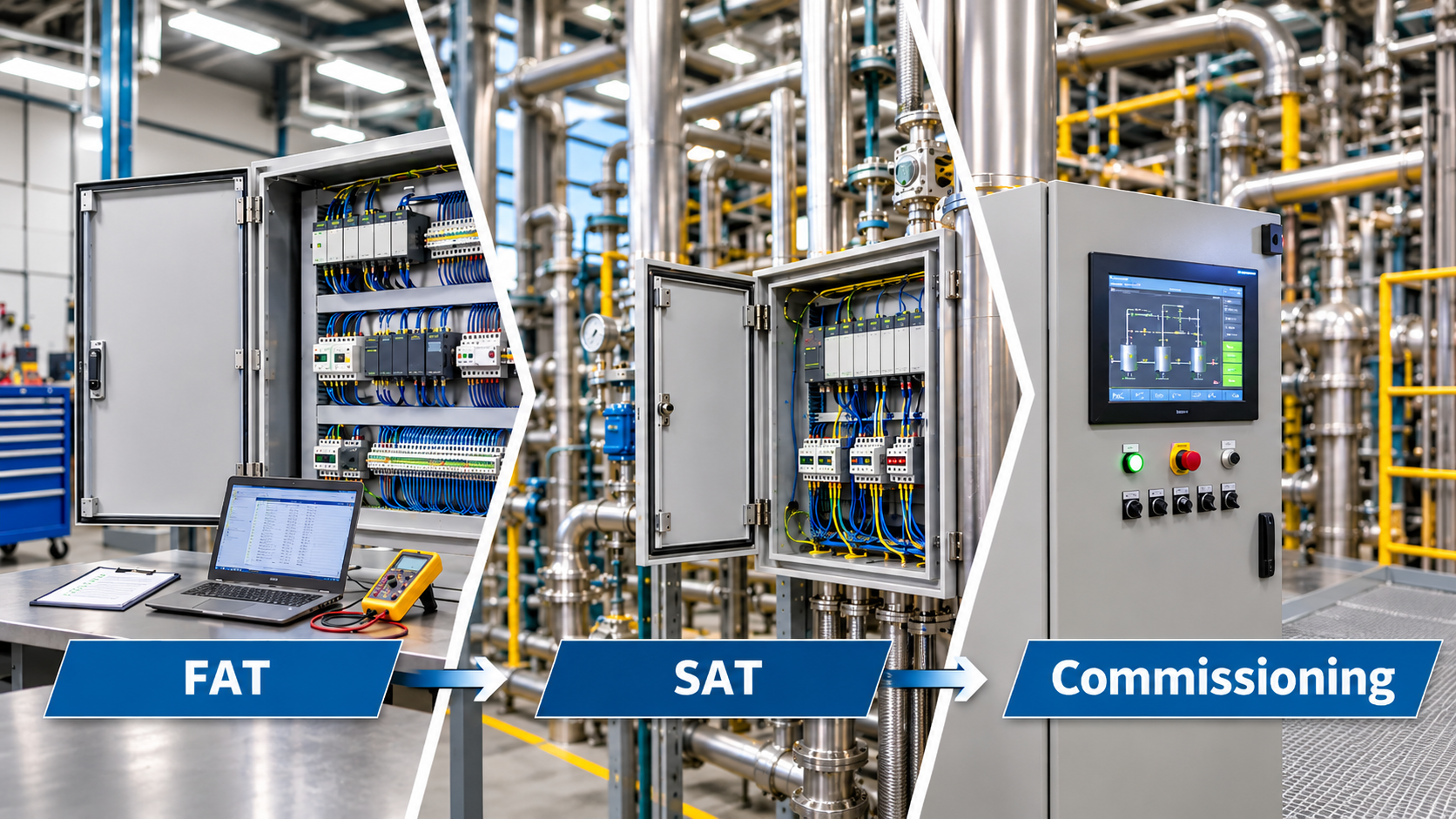
FAT is confirming what the supplier built, SAT confirms what was installed, and commissioning verifies the assembled operation is ready for use. A clear plan identifies which checks occur at each stage, what evidence constitutes acceptance, and who can authorize the next step.
Project responsible parties are usually the panel builder, electrical contractor, equipment OEM, controls integrator, and facility owner. The panel builder may test shop wiring and software, while the installing contractor verifies field connections and the owner provides access to process equipment and operators.
Test Records Are Useful Long After Startup
Signed results, updated electrical drawings, approved software revisions, open-item lists, and records of field changes create a baseline for future work. Documentation is particularly valuable when the original project team is no longer on site.
Planning for that also means preserving current PLC and HMI program files, a topic covered separately in this series.
AEC supports customers through field service and broader industrial control services, including installation, commissioning, and troubleshooting. The objective is not simply to pass a test, but to deliver a system that operators can run and maintenance teams can support.
Related Engineering Resources
- Factory Acceptance Testing (FAT) for Industrial Control Panels
A closer look at electrical verification, PLC/HMI testing, simulated field signals, and customer acceptance before shipment. - Control Panel Commissioning Checklist for Startup and System Handoff
Practical guidance on pre-power inspections, equipment startup, field device verification, safety testing, and documentation. - Reviewing Control Panel Shop Drawings Before Production Begins
How reviewing electrical drawings, panel layouts, I/O assignments, and component specifications helps identify problems before fabrication. - Common Control Panel Project Mistakes and How to Avoid Them
Common engineering and coordination problems that can complicate fabrication, acceptance testing, and commissioning.