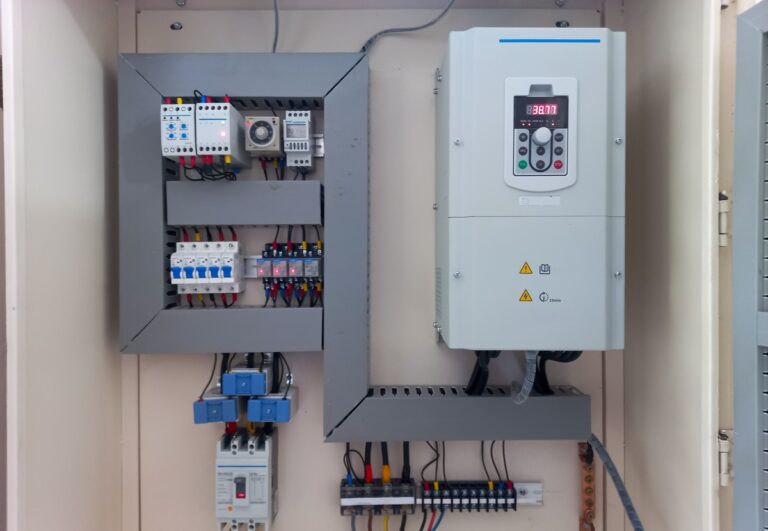

How Cable Design Improves VFD Performance
The manufacturing industry faces many challenges in the course of production. One of the top issues you may face is the effect of a harsh industrial environment on your electrical cables.
Variable frequency drives (or VFDs) that are used to regulate your conveyor belts, fans, and control pumps can wreak havoc on ordinary cables. And this in turn can cause equipment failure. So today we look at how cable design improves VFD performance.
Why Cable Design Is Important For VFDs
Most of you are familiar with VFDs. These motor drives work by varying frequency and voltage to control AC motor speed and torque. The right cable design is of the utmost importance for the smooth operation of your VFDs.
Good VFD cables will be able to handle the higher demands of VFDs that ordinary cables will not. Also, non-VFD cables and inferior quality cables will ultimately lead to impaired performance and equipment failure.
What Does A VFD Cable Do?
A typical good-quality VFD cable may perform three essential functions:
Firstly, it shields equipment from damaging electromagnetic interference. Secondly, it insulates against stray voltage and current loss. And finally, it reduces electromagnetic interference levels and common mode currents.
However, not all cables marketed as VFD cables perform all these functions, and some that do may not be doing so at the level that you require.
This is why you must use only top-quality VFD cables with the best design for industrial applications.
How The Right Cabling Improves VFD Performance
If you want to boost your VFD’s performance, and your productivity in general, you need the right VFD cabling. That means utilizing specialized cables that are specifically designed to withstand voltage spikes, stray voltage, charging currents, and RFI/EMI interference that is often created by VFD systems.
1. They Can Conduct High-Frequency Signals
The skin effect occurs when alternating current flows near the outer surface of an electrical conductor, and it’s more of a problem with higher frequencies. VFD signals have very high frequencies, and therefore the skin effect comes into play.
Cables with a high strand count, increased surface area, and tinned design for thermal stress, are better able to conduct high-frequency signals.
2. They Can Contain Charge Losses
THHN is a 600 V wire that has polyvinyl chloride (PVC) insulation. It is considered thermoplastic insulation. But cross-linked polyethylene (XLPE) and other cross-linked synthetic materials, like ethylene propylene rubber (EPR), are better cable insulators for wider voltage ranges.
This is because polyethylene has a low dielectric loss factor. It can be used at higher voltages than PVC. High-grade XLP conductors can contain charging losses far better than THHN cables.
3. Good VFD Cables Offer Greater Stability & Noise Reduction
Electrical noise from VFDs can affect the transmitted signal. This is where proper cable shielding is essential. The shielding material has a major effect on the noise from cables.
Most industries and factory floors make a lot of noise, but all the electrical energy can also cause electromagnetic interference. Properly shielded cables will improve your working conditions and prevent electromagnetic interference caused by the ensuing electromagnetic interference (EMI).
Low-impedance shielding offers less current reflection and superior shielding. It also plays a role in reducing the electromagnetic radiation emission from the cable. Dual copper tapes provide top shielding performance and are thus more stable.
A single terminated drain wire doesn’t have an adequate surface area to conduct the high-frequency noise to the ground, so it’s best to use a ground strap rather than a solid round wire for grounding and noise reduction. Also, VFD output filters don’t help with common mode current and high-frequency bearing currents.
There is no substitute for good quality VFD cables, which are designed to withstand these EMI and noise issues.
How To Know If You Need Better Cables For Your VFD And Other Equipment Performance
To check whether you need better cables, assess your site by asking the following questions:
- Are your cables suited for conditions surrounding VFD use?
- Do you have high levels of industrial noise, and does this affect the operation of your equipment?
- Do you need cables that can withstand strong charging currents?
- What about your EMI levels? Would they severely impact your instrumentation?
- Do your cables achieve all functions outlined in our “what does a VFD cable do” section, above?
High-grade VFD cables can assist with all these issues, not only to handle the higher demands placed on them, but also for improved productivity. The wrong cables can cause damage to your VFDs and other machinery, resulting in unnecessary and costly downtime.
Conclusion
When choosing cables for your factory or worksite, VFD cables are often the way to go. But even in the space of VFD cabling, there are varying degrees of performance. For the best high-performance VFD cables that feature optimized stranding, superior grounding, and the best shielding, contact us today.
Svend Svendsen is the principal owner and a certified electrical engineer at Automation Electric & Controls Inc. Svend has decades of panel building experience specializing in custom industrial control systems, motor control panels, operator consoles, automated control systems, and custom control trailers. Automation Electric and Controls Inc. is a licensed ETL 508A panel building shop.